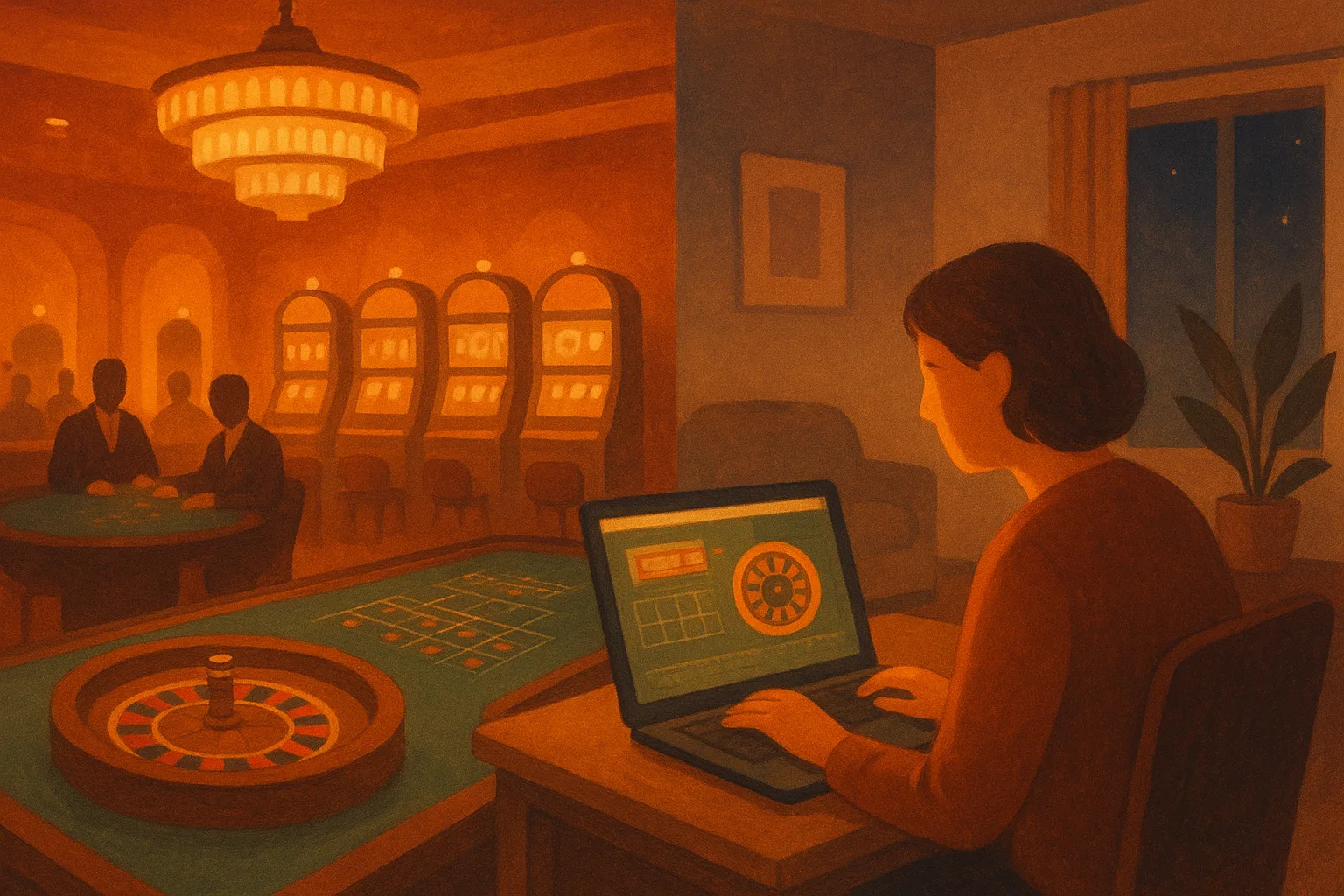
A single spin at American double-zero roulette carries a house edge of about 5.26%; under European single-zero rules it drops to roughly 2.7%. Where you meet that edge first—on a busy casino floor or on a quiet screen—shapes everything from how fast you lose money to how comfortable you feel learning.
Atmosphere and social experience
Step onto the main floor at the MGM Grand or Bellagio and the sensory design hits immediately: banks of slots, table-side chatter, free drink service for many players and pit bosses watching the action. Resorts such as Marina Bay Sands in Singapore or Casino de Monte-Carlo turn casino play into a full night out, with valet parking, dress codes in some rooms and a crowd that gathers around hot tables.
That atmosphere changes how newcomers behave. Many people linger longer than planned, pick up rules by watching, and feel encouraged to try games after seeing another player catch a streak. The experience is part casino, part theatre.
Online, the environment is whatever you make it. You might play blackjack on a tablet while dinner is in the oven or spin slots on your phone from the sofa. Live-dealer studios from providers such as Evolution, Playtech or Pragmatic Play use real dealers, physical tables and chat windows to mimic a high-end floor, but everything is mediated through a camera and your speakers.
If you enjoy people-watching, ritual and a sense of occasion, a land-based visit will feel richer. If you prefer privacy, no dress code and the ability to log out the moment you feel tired, online play fits better.
Game selection and variants
Large resort casinos typically run dozens of table games and a couple of thousand slot machines. Floors in Las Vegas or Macau focus on what their customers actually play: long rows of popular slots, multiple blackjack tables, busy craps pits, and baccarat rooms that cater to both mass-market and VIP players.
Online casinos reverse the constraint. A single site can host thousands of slots from studios such as NetEnt, Microgaming and Yggdrasil, plus niche table variants that would never earn their physical floor space. Lightning Roulette, Speed Baccarat, Megaways slots and regional card games are common in online lobbies, and new titles appear weekly.
Physical casinos have the quiet advantage of curation. A pit manager decides which blackjack rules to spread and how many roulette tables to run, which keeps the menu readable for a beginner. Online, you scroll through long lists of games and need to check each rules page yourself.
If you enjoy sampling unusual mechanics and hunting for specific return-to-player (RTP) percentages, online filters for RTP and stake size are helpful. If your priority is a crowded craps table, a long-running poker room or the drama of a high-limit salon, no online lobby replaces a physical venue.
Regulation, safety and fairness
Both formats are regulated, but the way that protection shows up is different.
Land-based casinos work under local licences. Bodies such as the Nevada Gaming Control Board or Macau’s Gaming Inspection and Coordination Bureau approve games, inspect equipment, and require surveillance, cash controls and staff licensing. You can see some of that structure on the floor: rules notices at tables, security staff, cameras, and ID checks at the cage.
Reputable online casinos publish their licence details in the footer. Strong regulators include the UK Gambling Commission, the Malta Gaming Authority and state-level agencies in places such as New Jersey or Ontario. A licence is a basic requirement, not a guarantee of good behaviour, but it filters out operators that never faced scrutiny at all.
Fairness online depends on certified random number generators. Good operators carry testing certificates from labs such as GLI, iTech Labs or eCOGRA, which audit the maths behind slots and table games. If you cannot easily find the licence number, regulator name and testing lab on an online site, treat that as a red flag.
Disputes are also handled differently. On a physical floor, a supervisor can review a hand or a machine on the spot. Online, you rely on the operator’s complaints process and, if needed, the regulator’s dispute channels, which take longer and feel more distant.
For a deeper look at how Global Casino Atlas weighs licence quality, RTP and rulesets when comparing venues, see Welcome to the Global Casino Atlas: How to Read Our Guides.
Costs, bonuses and comps
The house edge sets your expected loss over time. Blackjack with favourable rules and solid basic strategy can bring that edge close to 0.5%, while most slots sit several points higher and vary widely between titles. That mathematical reality applies whether you play in a resort or at home.
Around it sit practical costs. A land-based evening includes transport, parking or taxis, meals, and often a hotel room if you stay late. Many big-city properties charge resort fees that push a short trip into the hundreds of dollars once everything is added up. Table minimums at busy hours can be much higher than a newcomer expects, so read the sign before you take a seat.
Online, minimum deposits of around $10 or £10 are common, and many slots let you set stakes as low as $0.10 per spin. Table games frequently offer limits starting near $0.50 or the local equivalent. This lower barrier lets you try several games while keeping financial pressure modest, provided you respect your own limits.
Bonuses are a major online difference. Welcome offers with matched deposits or free spins look generous but come with wagering requirements, often in the 20x–40x range on the bonus amount or on both deposit and bonus. Many sites also restrict which games contribute fully; slots usually count 100%, while some table games count at a reduced rate or not at all. A bonus is only worthwhile if it fits games you already planned to play.
Comps take different shapes too. Land-based casinos reward tracked play with tangible perks such as free rooms, meals and show tickets, linked to loyalty cards swiped at tables and machines. Online, loyalty programmes typically pay out as points, cashback, or tiered VIP benefits. These are easier to earn at low stakes but feel less concrete than waking up in a comped hotel room.
Pace, learning curve and control tools
Speed is one of the most underestimated differences for new players. A live blackjack table with several players might see in the region of 60–80 hands per hour, depending on how chatty the dealer and table are. The same rules on a fast online table can produce roughly 150–200 decisions in that time. Roulette wheels online can spin far more frequently than a physical game where the croupier clears chips and calls the next round.
More decisions per hour mean the house edge gets more chances to work on your bankroll. A session that feels short in clock time can represent a lot of individual bets.
Online play has real learning advantages. Most reputable sites offer free-play or demo modes where you can try games without risking money. Running dozens of hands of blackjack in a demo mode while you follow a basic strategy chart is one of the most efficient ways to internalise decisions before you ever place a real chip.
Land-based casinos, by contrast, build pauses into the experience. You walk between tables, wait for other players, and have time to ask dealers to clarify rules. Many properties run beginner-friendly lessons during quieter hours, and staff are usually happy to answer simple questions.
The right casino for a newcomer is not the one with the flashiest bonus, but the one that makes stopping and walking away feel easy.
Control tools exist on both sides, but you have to use them. Online, you can usually set deposit limits, loss limits, session time reminders and self-exclusion periods in your account settings. In Great Britain, schemes such as GamStop allow you to block access to all UK Gambling Commission–licensed online casinos in one step, though they do not cover sites that operate solely under offshore licences.
On the physical side, the main tools are decisions you make in advance. Setting a fixed cash budget, leaving cards in the hotel room, and planning a firm end time before you walk in are simple habits that experienced players rely on. If you recognise that you are struggling to stop, most jurisdictions now offer formal self-exclusion programmes for land-based casinos, which you can apply for through regulator or venue channels.
Practical checklist for newcomers
- Licence and testing: pick casinos and sites that name a recognised regulator and show certificates from independent testing labs.
- Budget: decide a session bankroll before you start. For a land-based visit, include travel, food and tips. For online play, set deposit and loss limits and respect them.
- Game rules: check table signage or game information screens. Look for blackjack payout ratios (3:2 vs 6:5), roulette wheel type (single-zero vs double-zero) and slot RTPs.
- Pace: favour slower options when learning. Avoid playing multiple online tables at once until you are comfortable with the decisions.
- Bonuses and comps: read the terms on wagering and contribution rates, and treat comps as a nice extra, not a reason to extend a losing session.
A practical next step
If you expect to spend under about $50 per session while you learn, starting with a licensed online casino that offers demo modes and low-stake tables makes sense. Use the practice modes to get comfortable with rules and house edges, then move to small real-money stakes only when you can explain each decision you make.
If your goal is a social night out with friends and an entertainment budget in the region of $150–$300 including travel and food, choose a reputable land-based property, read the table minimums before you sit down, and treat any losses as part of the evening rather than as a bill to recoup later.
Many experienced players combine both approaches. They learn mechanics online, then visit a physical casino once the fundamentals feel automatic. Whichever route you take, let licence quality, clear rules and the ability to stop easily guide your choice more than the size of a bonus or the brightness of the lights.